The Peloponnese Is About to Get Busy. Thank Christopher Nolan.
Nolan's The Odyssey opens July 17 and its Greek filming locations are about to surge. Where to stay in the Peloponnese before prices catch up.
Christopher Nolan's The Odyssey opens in theaters tomorrow, July 17. Matt Damon plays Odysseus. The budget was enormous, the IMAX bookings are sold out weeks ahead, and the trailer has been watched hundreds of millions of times. Almost nobody watching it realizes they're looking at the southwest corner of the Peloponnese.
We've seen this movie before, so to speak. A blockbuster films somewhere photogenic, the film lands, and within months the filming locations show up on every itinerary. It happened to Sicily after The White Lotus. New Zealand has run a Lord of the Rings tourism economy for two decades. The Peloponnese is next, and right now, before the crowds arrive, is the moment to plan a trip.
Where Nolan Actually Filmed
The production shot across Italy, Iceland, Morocco, Scotland, and Greece. The Greek scenes centered on the Peloponnese, the large peninsula that hangs off the bottom of the mainland like an open hand.
Three locations stand out. Voidokilia Beach in Messenia is a nearly perfect semicircle of sand, an omega shape you recognize instantly from above. Methoni Castle sits on a promontory surrounded by sea, connected to land by a narrow stone bridge. And Acrocorinth, the fortress rock above ancient Corinth, rises more than 500 meters with walls wrapping the entire hillside.
None of these are secrets to Greeks. All of them are secrets to most international travelers, who land in Athens and sail straight to Santorini or Mykonos without ever pointing a rental car south.

The Set-Jetting Effect Is Real
Travel marketers call it set-jetting, planning trips around filming locations. It moves real money. Sicily's hotels rode a wave of bookings for two full seasons after The White Lotus aired. Tourism boards now compete to attract productions specifically because the visitor bump is so reliable.
Greece's tourism ministry has been openly promoting the Nolan connection since filming wrapped. Expect the Peloponnese to appear in every "where to go in 2027" list published this fall. Hotel supply in the region is limited, especially in Messenia, and limited supply plus a demand spike means one thing for prices. They go up.
A mid-range hotel in Pylos, the harbor town nearest Voidokilia, currently runs about $90 to $150 per night in high season. We'd be surprised if that range survives the summer of 2027 intact.

Where to Stay in the Peloponnese
Pylos and Messenia, for the film locations
Pylos is the natural base for Voidokilia and Methoni. It's a working harbor town with a plane-tree square, waterfront tavernas, and family-run guesthouses in the $80 to $140 range. Voidokilia is 20 minutes north by car. Methoni Castle is 15 minutes south. If you want a resort instead, Costa Navarino sits just up the coast with several five-star properties from around $400 per night, and its golf courses and spa draw a crowd that never realizes the best beach in Greece is next door.
Kardamyli and the Mani, for the wild side
Two hours east of Pylos, the Mani peninsula is stone towers, cypress trees, and a coastline that drops straight into the sea. Kardamyli was Patrick Leigh Fermor's home for a reason. Small hotels and restored tower houses here run $100 to $180 per night, and October swimming is entirely realistic.
Nafplio, for the Corinth side
If Acrocorinth is your target, base in Nafplio, arguably the prettiest town on mainland Greece. Venetian mansions, a hilltop fortress of its own, and boutique hotels from $100 to $200 per night. Corinth is an hour's drive. Athens is two, which makes Nafplio an easy first or last stop.

Worth Folding Into the Same Trip
The Peloponnese holds an outsized share of Greece's headline antiquity, and the distances between sites are small enough that a film-location trip picks them up almost by accident. From Nafplio, the theater of Epidaurus is 40 minutes away, still acoustically perfect after 2,300 years, still hosting summer performances where a whisper from the stage reaches the top row. Mycenae, the citadel of Agamemnon, is 30 minutes in the other direction. Anyone driving between the Corinth side and the Messenia side passes within reach of Ancient Olympia, birthplace of the games, which deserves the two-hour stop.
Further south, Monemvasia is the one to plan around. It's a fortified medieval town carved into the seaward face of a rock island, invisible from the mainland, reached by a single causeway. Rooms inside the walls run $120 to $250 per night and sell out fast in fall. Even if you don't sleep there, the detour earns its miles.
A One-Week Route That Works
Fly into Athens, pick up the car, and drive 90 minutes to Nafplio for two nights, covering Acrocorinth, Epidaurus, and Mycenae from one base. Cross the peninsula to Kardamyli for two nights of Mani coastline and mountain villages. Finish with three nights in Pylos for Voidokilia, Methoni, and the beaches of Messenia, then fly out of Kalamata or drive the four hours back to Athens. Seven nights, three bases, no day over three hours of driving.
Doing it in reverse works equally well in October, when Messenia's sea is warmest at the start of the trip.
When to Go and How to Book It
September and October are the answer. The sea is at its warmest, the light turns gold, and rates drop 20 to 30 percent from August peaks. We made the broader case in our guide to September shoulder season in Europe, and the Peloponnese might be the single best example of it.
Book the film-location hotels early. Pylos has a small bed count, and the post-release attention will concentrate there first. Our data on when to book hotels says one to three months out is the sweet spot for regional Greece, and setting a price alert now costs you nothing.
One more number worth knowing. Book a $130 Pylos guesthouse through Best (best.so) and 10 percent comes back as cashback, about $91 returned over a week. That covers a very good dinner in the plane-tree square.
The Budget Snapshot
For two people in shoulder season 2026, a Peloponnese day looks like this. A good double room averages $110 to $140. A rental car with fuel runs $55 to $70. Dinner for two at a village taverna with house wine lands between $35 and $50, and site entries add $10 to $20. Call it $220 to $280 per day for a trip that would cost double on the islands, before the cashback comes off the hotel line. Two travelers splitting it are each on a mid-range European city-break budget while standing on beaches Nolan flew a film crew across the world for.
Questions Travelers Are Asking
Can you visit the actual filming locations from The Odyssey in Greece?
Yes. Voidokilia Beach, Methoni Castle, and Acrocorinth are all public and open to visitors. Voidokilia is free. Methoni and Acrocorinth charge small entry fees, usually under 10 euros.
What's the closest airport to Voidokilia Beach?
Kalamata International Airport is about 50 minutes away by car and receives seasonal direct flights from much of Europe. Athens is a four-hour drive with better flight connections and cheaper fares.
How expensive is the Peloponnese compared to the Greek islands?
Cheaper, and it isn't close. A hotel that costs $250 a night on Santorini has a $120 equivalent in Pylos or Kardamyli. Meals, car rental, and entry fees all run 30 to 50 percent below island prices as of mid-2026.
Do you need a car in the Peloponnese?
Yes. Public transport between the film locations is sparse. Rental cars from Kalamata or Athens run $35 to $60 per day in shoulder season.
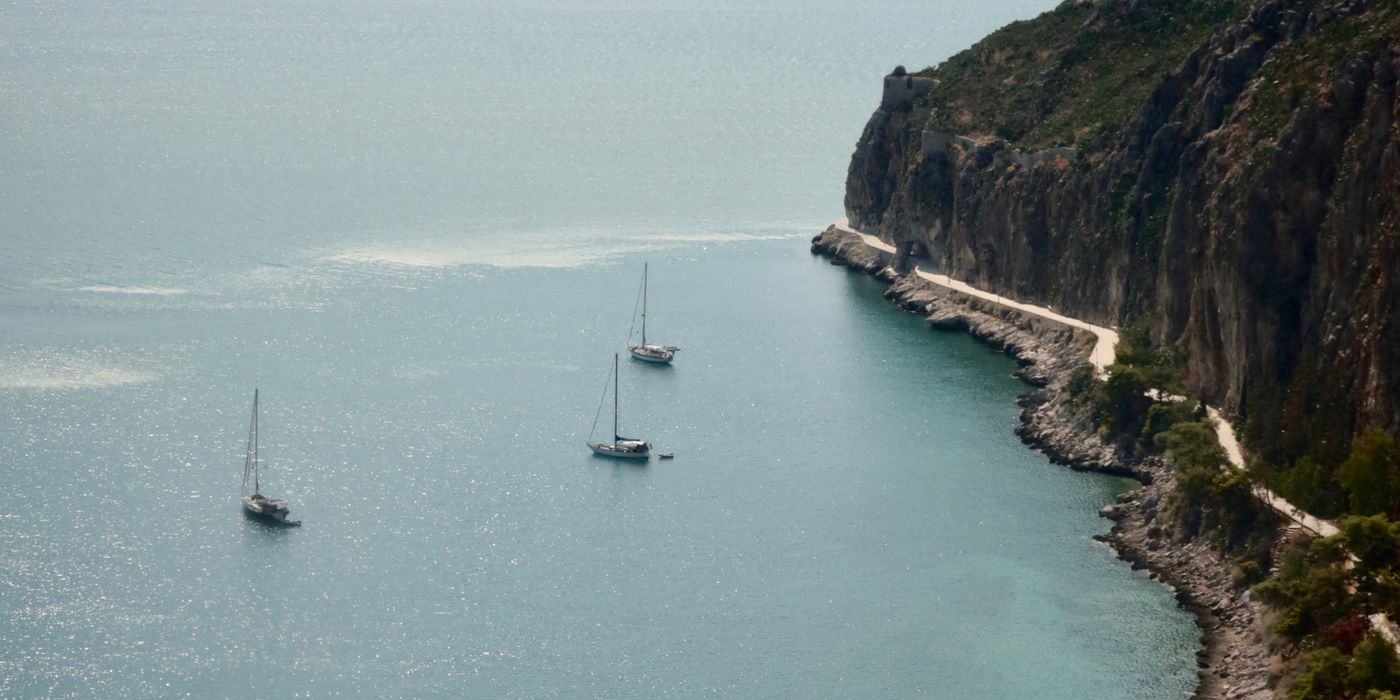
Images. Hero, Nafplio coastline by Farzona Comnas via Pexels. Voidokilia Beach by Grzontan and Acrocorinth by George E. Koronaios via Wikimedia Commons, used under Creative Commons licenses. Coastal aerial by Thanos Skoufitsas via Pexels.