Northern Lights Season Opens in Tromso. Go in Autumn, Not December
Aurora season opens in late August. September and October give you the same odds as December at roughly half the price, plus daylight worth using.
Aurora season in Tromso opens in late August and runs through early April. Most people book it for December, which is the worst month to go and the most expensive one.
Bookings for Nordic and Arctic regions are up sharply for 2026, and Tromso is the destination absorbing most of that. It sits at 69 degrees north, directly under the auroral oval, with an airport that connects through Oslo in under two hours. That combination is rare enough that the town of 77,000 people now handles well over a million visitors a year.
Here is how to do it in autumn, before the winter crowd and the winter prices arrive.
Why September and October beat December
The aurora does not care what month it is. Solar activity drives it, and the equinox periods around late September and late March are statistically the strongest windows of the year for geomagnetic activity. September and October give you as good a chance of a display as any winter month, and arguably better.
What changes is everything around it.
In late September the temperature sits around 5 to 8 degrees Celsius rather than minus 10. You can stand outside for three hours waiting without specialist clothing. The mountain roads are clear and unstudded rental cars are fine. Hiking is still possible, so your daylight hours have something to fill them with. The autumn colors on the birch slopes above the fjords are genuinely worth the trip on their own.
And the rates. A well-located Tromso hotel that runs 320 to 450 dollars a night in the December to February peak sits at 140 to 220 in late September and October. Aurora tour operators charge roughly 130 to 160 dollars per person in autumn against 190 to 240 in deep winter.
The one real trade is darkness. In late September Tromso gets about eleven hours of night, which is plenty. By December it is dark almost around the clock, which sounds better for aurora viewing but mostly means you are cold for longer.

Where to stay
Tromso city centre
The island core, walkable end to end in twenty minutes. This is where you want to be for a first trip. Restaurants, the harbour, tour pickup points, and the bus to the cable car are all here.
Autumn rates run 140 to 220 dollars a night for a good mid-range hotel, and 90 to 130 for the guesthouse tier. The harbourfront properties charge a premium of maybe 40 dollars for a view you will mostly see in the dark.
Stay here if you are doing guided aurora tours, which most first-timers should.
Tromsdalen, across the bridge
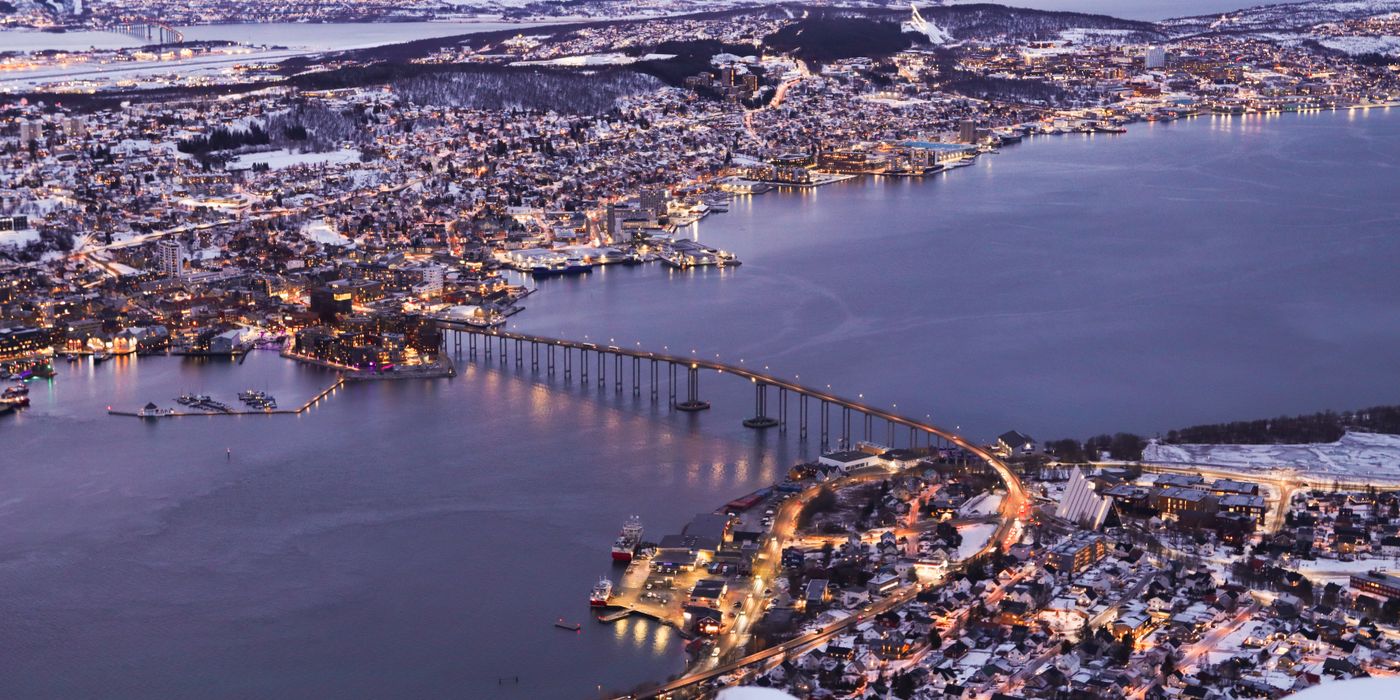
The mainland side, five minutes by car from the centre and reachable on foot across the bridge in about twenty. This is where the Arctic Cathedral and the Fjellheisen cable car are.
Rates run 15 to 25 percent below the island for equivalent quality. Light pollution is marginally lower. If you have a car, this is the better value base.
Kvaloya and the outer fjords
Thirty to sixty minutes west, out past the airport toward Ersfjordbotn and Sommaroy. Cabins, small lodges, and a handful of design-forward hotels sitting on water with mountains behind them.
This is where you go if you want to chase the aurora yourself rather than book a tour. Dark skies, no streetlights, and you can step outside your room at midnight instead of sitting in a minibus. Rates run 180 to 380 dollars a night in autumn, and you absolutely need a car.
The catch is weather. If clouds sit over your fjord, you are stuck with them. Tour operators move, and that mobility is the entire product they sell.
What to do with the daylight
Autumn is the only aurora season where the days are useful, so use them.
Fjellheisen cable car. Four minutes to 421 metres and the standard view over the island and the sound. Go at sunset, which in late September lands around 8pm and lasts a long time at this latitude. There is a marked trail continuing up to Storsteinen if you want the walk.
The Sherpa Steps. 1,200 stone steps up the mountain beside the cable car, built by Nepali stonemasons. Free, about an hour up, and the reason half the town looks fit.
Kvaloya day loop. Drive out to Ersfjordbotn, continue to Sommaroy, and come back the other way. Two hours of driving through some of the best coastal scenery in northern Norway, plus white-sand beaches that look tropical until you touch the water.
Polaria and the Polar Museum. Worth ninety minutes each on a rainy afternoon, and it rains here.
Whale watching. The herring arrive in November, so autumn trips before then are hit and miss. If whales are the priority, that is a November to January trip, not a September one.
Eat at. Fiskekompaniet for a proper fish dinner on the harbour. Raketten Bar for a hot dog from a tiny yellow kiosk that has been there since 1911. RisO for coffee and the best breakfast in town.

How to actually see the aurora
Two approaches, and the right one depends on whether you have a car.
Guided minibus tours. A guide watches cloud cover across a 300-kilometre radius and drives to wherever the sky is clear, sometimes crossing into Finland. In autumn these run 130 to 160 dollars per person for six to eight hours, usually with a fire, soup, and someone who knows how to set up your camera. Book two or three nights rather than one. A single night is a coin flip.
Self-drive. Rent a car, pull up a cloud cover forecast and an aurora forecast, and drive away from the clouds. Cheaper across a week and infinitely more flexible. Requires you to be comfortable driving unlit mountain roads at night, which in autumn is manageable in a way it is not in February.
Either way, three nights minimum. The aurora is reliable across a week and completely unreliable across a night. People who book two nights in December and see nothing were not unlucky. They were under-booked.
What a week costs
Five nights in late September for two people. A mid-range city centre hotel at 180 dollars a night is 900 dollars. Two guided aurora tours at 145 per person is 580. Car rental for three days is around 270. Food at roughly 120 dollars a day for two is 600. Cable car and museums, 90.
That lands at about 2,440 dollars excluding flights. The same trip in January runs closer to 3,700, for worse weather and no hiking.
Booking the 900 dollars of accommodation through Best returns 90 dollars as cashback, which covers most of one aurora tour.

Common questions
Can you really see the northern lights in September?
Yes. Aurora season in Tromso runs from late August to early April, and the weeks around the September equinox are among the most geomagnetically active of the year. You need darkness and clear skies, both of which September provides. What you do not get is the round-the-clock darkness of midwinter.
How many nights should I book to see the aurora?
Three minimum, four or five ideally. Cloud cover is the limiting factor rather than solar activity, and clear skies in coastal northern Norway are a matter of patience. Across three nights of active chasing, most visitors see something.
Is Tromso cheaper in autumn than winter?
Substantially. Hotel rates in late September and October run roughly 40 to 55 percent below the December to February peak, and aurora tours run about 30 percent less. Flights follow the same pattern.
Do I need a car in Tromso?
Not if you are staying in the centre and booking guided tours. Yes if you are staying out on Kvaloya or chasing the aurora yourself. In autumn a standard rental is fine, which is not true once the roads ice over.
The short version
Go in late September or October. Stay in the city centre if you are taking guided tours, Tromsdalen if you want the same access for less, and Kvaloya if you have a car and want dark skies outside your door. Book at least three nights of aurora chasing. Bring a waterproof shell, because the enemy here is rain, not cold.
If you are booking Tromso hotels, Best returns 10 percent of the room rate as cashback at best.so. In a country where a mid-range room is 180 dollars a night, that adds up quickly.
Images: Hero via Pexels. Aurora over the fjord via Pixabay. Tromso harbour and bridge via Pexels. All used under license.



