Where to Stay in Budapest. A 2026 Neighborhood Guide
The best Budapest neighborhoods for 2026, with real nightly hotel prices for District V, the Jewish Quarter, Buda Castle, and where to eat.

Budapest rewards the traveler who picks the right side of the river. The city splits down the middle. Buda climbs a set of hills on the west bank, quiet and old and heavy on views. Pest spreads out flat on the east bank, where most of the restaurants, bars, and late nights actually happen. The district you book decides which of those two cities you wake up in.
We book a lot of rooms here, and the mistake is always the same. People pay for a castle view, then spend every evening hauling themselves back across a bridge at midnight. Or they grab a cheap room three tram stops from anything and lose an hour a day to transit. Getting the neighborhood right is worth more than getting the star rating right.
Here is how the central districts actually differ, what a room costs in each for 2026, and who each one suits.
Budapest is a spiral, and the low numbers are the ones you want
Budapest has 23 districts, numbered in a spiral that starts at the castle and winds outward. You do not need to learn all of them. The center you came to see sits inside districts V, VI, and VII on the Pest side, plus district I around the castle on the Buda side. Any low Roman numeral is close to the action. Once you get into the teens, you are in residential neighborhoods where hotels are cheaper and mornings start with a commute.
Nightly hotel prices in 2026 break down roughly like this. Budget rooms run $50 to $80. Mid-range hotels sit around $120 to $250. The luxury tier starts near $300 and climbs past $800 for the riverfront grande dames. Those numbers swing hard with season, which we get to at the end.
District V, Belvaros. Best for a first trip
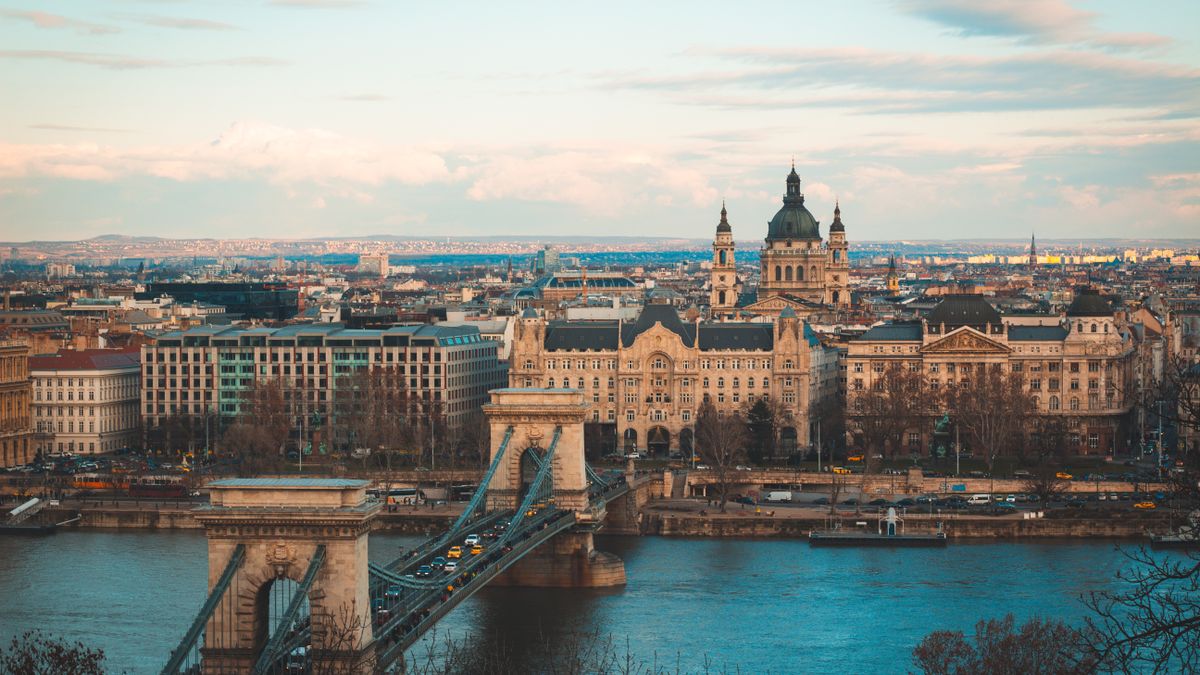
If this is your first time and you want to think about your location as little as possible, book District V, the Inner City. It runs along the Pest riverbank and holds the postcard sights. The Parliament building, the Danube promenade, the Chain Bridge landing, and St Stephen's Basilica are all walkable from here, and the M1, M2, and M3 metro lines converge nearby so the baths and the outer sights are a short ride away.
The trade is price and buzz. District V is the most polished part of the city and it charges for it. Expect mid-range hotels around $140 to $260 a night in 2026, with the riverfront five-stars well past $400. It is also quieter after dark than District VII, which some people want and some people do not. For a two or three night trip where you want everything at your feet, it is the safe pick.

Buda Castle District. Best for views and quiet
The Castle District in district I sits up on the hill in Buda. This is the atmospheric Budapest, cobbled streets, Fishermans Bastion, Matthias Church, and the long view back over the river to Parliament. Mornings here are calm and the light is worth the climb.
The catch is that everything involves the climb. You will walk more, and a late dinner in Pest means a funicular, a bus, or a cab back up at the end of the night. Rooms are limited and lean boutique, so mid-range runs about $150 to $280. Pick this area if the view and the calm matter more than rolling out of bed into a bar. Couples love it. Anyone planning three nights out on the town will get tired of the hill.
District VII, the Jewish Quarter. Best for nightlife and food
District VII is where Budapest earned its reputation as a party city. This is the Jewish Quarter, home to the Great Synagogue and to the ruin bars, the courtyards of half-demolished buildings that got filled with mismatched furniture and turned into the most famous nightlife in the region. Szimpla Kert started it. The streets around Kazinczy utca run late and loud.
It is also, quietly, the best food neighborhood in the center, dense with cafes, street food, and modern Hungarian kitchens. Rooms here run about €150 to €350 for the good mid-range hotels, with cheaper design hostels and apartments underneath that. Book District VII if you want to walk home from dinner and a bar. Book somewhere else if you want silence by 11pm, because the courtyards carry sound.

District VI, Terezvaros. The quieter middle ground
District VI wraps around Andrassy Avenue, the tree-lined boulevard that runs from the center out to Heroes Square with the yellow M1 metro line, the oldest on the European continent, running right underneath it. This is the balance option. You are one street over from the District VII nightlife without sleeping on top of it, close to the opera house and some of the city's better restaurants, and rooms tend to run a notch cheaper than District V at roughly $110 to $220.
We point a lot of second-time visitors here. You keep the central location, you drop the price a little, and you trade the loudest blocks for tree-lined ones. The M1 makes the baths and Heroes Square a five minute ride.
What each neighborhood costs in 2026
Here is the quick version, mid-range nightly rates for 2026, so you can match a district to a budget before you start clicking.
| Neighborhood | Best for | Mid-range nightly rate |
|---|---|---|
| District V, Belvaros | First trip, sights on foot | $140 to $260 |
| Buda Castle, District I | Views, quiet, couples | $150 to $280 |
| District VII, Jewish Quarter | Nightlife, food | $165 to $385 |
| District VI, Terezvaros | Balance, better value | $110 to $220 |
Getting around, and why you can book slightly out
Budapest has a genuinely good transit system, and that changes the math on location. The metro, trams, and buses run on one ticket, a single ride is a few hundred forint, and a 72 hour travel card covers most short trips. Tram 2 runs right along the Pest riverbank and is basically a sightseeing ride at commuter prices. Because transit is this easy, you can book one district out from the center, District VI or the inner edge of District VIII, and save real money without adding much friction to your day.
One habit worth keeping. Before you commit to a hotel, drop its exact address into a map and check the walking time to the nearest metro stop, not just to the city center. A room that looks central can still be an eight minute uphill walk from the nearest station, and that adds up over a few days.
When to go, and where the price actually moves
Budapest is a shoulder-season city. Late September through November and March into May bring mild weather, thinner crowds, and rates that sit well below the July and August peak. Fall is the sweet spot. The thermal baths, Szechenyi and Gellert, are better in cool weather anyway, and autumn rooms in the center often run 20 to 30 percent under summer.
December is its own thing. The Christmas markets around Vorosmarty Square and St Stephen's Basilica pull crowds and push rates back up, so if you are chasing the markets, book early. January and February are the cheapest months to sleep in a good central hotel, and the baths are at their best with steam rising off the water in the cold.
Whenever you book, the same room usually shows up across several sites at slightly different prices, and the amount you get back afterward can matter as much as the sticker rate. If you book your Budapest hotel through Best, that mid-range room comes with 10 percent cashback, which on a four night stay is real money back toward the flight home. Worth checking against whatever rate you were about to take.
Frequently asked questions
Is it better to stay in Buda or Pest? For most trips, Pest. The restaurants, bars, and central sights are concentrated on the Pest side, and districts V, VI, and VII put you in walking distance of nearly everything. Stay in Buda around the Castle District if views and quiet matter more to you than nightlife.
Which district is best for first-time visitors to Budapest? District V, the Inner City, is the easiest base for a first trip. It holds the Parliament, the basilica, and the riverfront, and the main metro lines meet nearby, so you can reach the baths and outer sights in minutes.
How much does a hotel in Budapest cost in 2026? Budget rooms run about $50 to $80 a night, mid-range hotels sit around $120 to $250, and luxury properties start near $300. Central districts and summer dates push toward the top of each range, while fall and winter drop rates 20 to 30 percent.
Is the Jewish Quarter a good place to stay? Yes, if you want food and nightlife on your doorstep. District VII has the best restaurant density and the famous ruin bars. It is loud at night, so choose a hotel a block off Kazinczy utca if you are a light sleeper.
Images: Hero (Parliament at night) by Moyan Brenn, CC BY 2.0. Danube panorama from Fishermans Bastion by Hal9000beta / Daniel Pauls, CC BY 3.0. Szimpla Kert by Yelkrokoyade, CC BY-SA 3.0. All via Wikimedia Commons. Additional images via Pexels.