Where to Stay for Oktoberfest 2026 Without Paying Munich Prices
Oktoberfest runs 19 September to 4 October 2026. A neighbourhood-by-neighbourhood look at Munich rates, and why walking distance is the most expensive thing you can book.

Oktoberfest 2026 runs from 19 September to 4 October, and Munich hotel rates have already done the thing they do every year. A room that costs around €110 in the second week of September costs three times that on the festival’s opening weekend, in the same building, with the same view of the same courtyard.
Most guides tell you to book near the Theresienwiese. That is the single most expensive instruction in German travel. The festival grounds sit in the middle of a city with an excellent underground system, and the difference between a fifteen-minute walk and a fifteen-minute U-Bahn ride is roughly €150 a night.
Here is how Munich actually breaks down for the sixteen days of the Wiesn.
What the festival does to Munich rates
Outside the festival window, Munich hotels generally run €80 to €150 a night for a decent mid-range room. During Oktoberfest, mid-range properties near the grounds move to roughly €200 to €350, and anything within walking distance of the Theresienwiese can reach €300 to €500 on weekends.
Hotels sitting near any U-Bahn stop, twenty to thirty minutes from the grounds, land closer to €150 to €250. That single decision, walkable versus connected, is worth more than every other booking trick combined.
The second weekend, 26 and 27 September, is historically the most expensive stretch of the entire year in Munich. German visitors dominate that weekend and they book early. Weekday nights across the festival run noticeably cheaper, and the drop between a Saturday and the following Tuesday is often 40% or more.
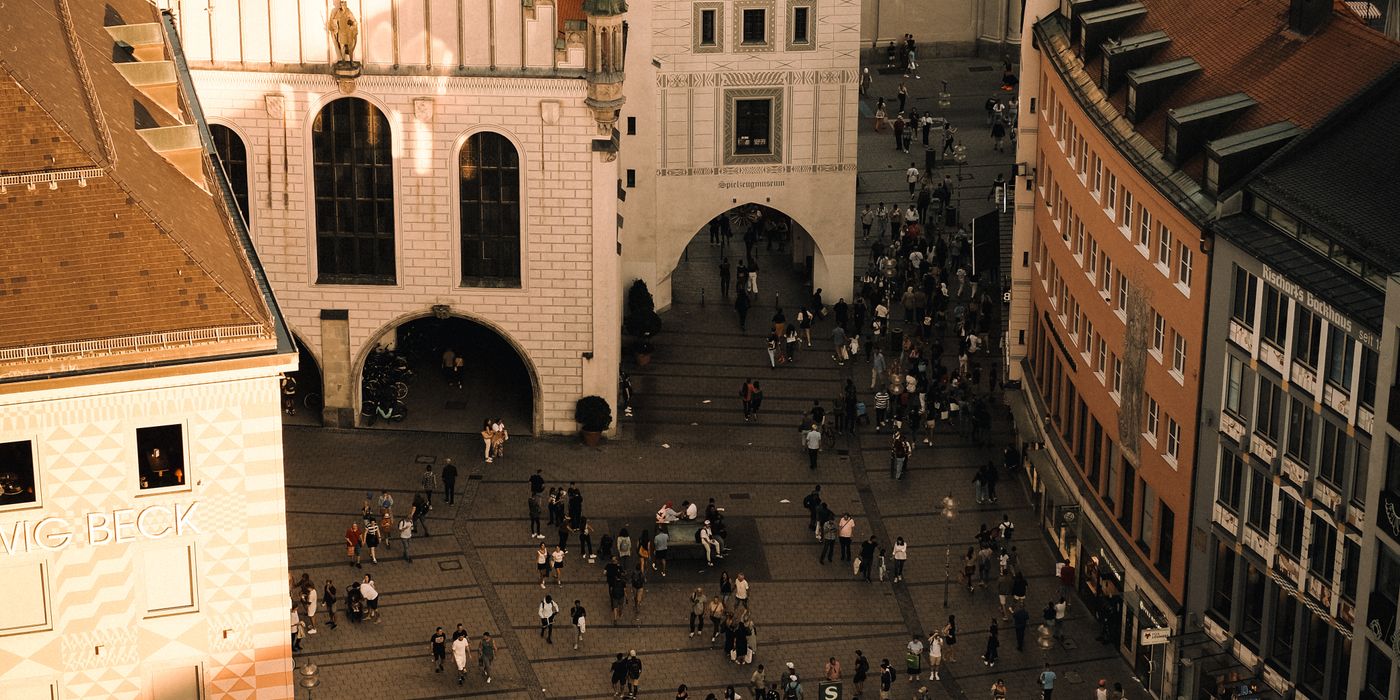
Ludwigsvorstadt and the station quarter
Walk to the grounds. Five to twelve minutes.
Festival rate band. Roughly €250 to €450.
This is the strip between Hauptbahnhof and the Theresienwiese, and it is where most first-time visitors end up. The convenience is real. You can leave a tent at 11pm and be in bed in ten minutes, which matters more than you think after eight hours in a beer hall.
The trade-off is that the area around the main station is the least charming part of central Munich, and during the festival it is loud until roughly 2am every night. Rooms facing the street are not worth booking here. Ask for a courtyard side and mean it.
Book this area only if the walk genuinely matters to you, for example if someone in the group has mobility issues or you have small children going to the fairground rides during the day.
Westend and Schwanthalerhöhe
Walk to the grounds. Ten to twenty minutes.
Festival rate band. Roughly €180 to €320.
Directly west of the Theresienwiese and, for our money, the best compromise in the city. Westend is a residential district of nineteenth-century apartment blocks, Turkish and Italian grocers, and small restaurants that mostly ignore the festival entirely.
You can walk home. You can also eat a normal dinner on Gollierstraße for €15 on a night when the tents are charging €19 for a roast chicken. The Verdi bakery on Ganghoferstraße opens at 6am, which becomes relevant on day three.
Rates here run €80 to €150 cheaper than the station quarter for what is often a nicer room.

Altstadt and Marienplatz
Journey to the grounds. Eight minutes by U-Bahn, or a twenty-five minute walk.
Festival rate band. Roughly €220 to €400.
The old town is expensive during the festival but it is expensive year-round, which means the festival premium is proportionally smaller here than it is next to the grounds. If you were going to pay €200 for Altstadt in June, you are paying €300 now. Next to the Theresienwiese the same room went from €110 to €350.
You also get a city rather than a festival annex. The Viktualienmarkt beer garden, the Hofbräuhaus if you insist, Residenz, and every tram line in Munich. U4 and U5 from Karlsplatz put you at Theresienwiese in two stops.
Worth booking if you want the trip to be about Munich with Oktoberfest attached, rather than the reverse.
Maxvorstadt
Journey to the grounds. Twelve to eighteen minutes.
Festival rate band. Roughly €150 to €260.
The university district, north of the Altstadt. Three of the best art museums in Europe, a student population that keeps food prices honest, and a set of small hotels that price like it is a normal week because most of their guests are there for the Pinakothek rather than the Wiesn.
This is the value pick for anyone who wants to be in a genuinely nice neighbourhood and does not mind a short ride. Augustiner Bierhalle on Neuhauser Straße is a fifteen-minute walk and serves the same beer without the reservation problem.
Haidhausen
Journey to the grounds. Eighteen to twenty-five minutes.
Festival rate band. Roughly €140 to €240.
Across the Isar to the east, built around Wiener Platz and the Franzosenviertel. Quiet, leafy, full of the kind of restaurants Munich residents actually book. If you want to sleep, book here.
The catch is the journey home. Getting back from the Theresienwiese to Haidhausen late at night involves a change, and after several litres of beer, changes go wrong. Screenshot the route before you go out.
Going outside Munich entirely
The S-Bahn network reaches a long way, and rates fall off a cliff once you leave the city boundary. Reported festival-period rooms in Gilching and Erding have run around €107 to €108 a night, against €300-plus for something comparable near the grounds.
Augsburg is the strongest of these options. Forty minutes by regional train, a genuinely handsome city with its own beer culture and Fuggerei almshouses, and hotel rates that barely register the festival at all. Dachau, Freising, and Starnberg all work on the same logic.
The maths is straightforward. Four nights at €120 in Augsburg against four nights at €320 near the Theresienwiese saves €800, and the train costs about €15 each way. The cost is the last train home, so check the timetable rather than assuming.
Timing, which matters more than location
The opening Saturday and the second weekend carry the highest rates of the sixteen days. The final week is measurably cheaper and the tents are just as full, since German visitors have largely been and gone.
Arriving Sunday and leaving Thursday is the single best-value pattern. You get four festival days, you skip both weekend spikes, and Munich hotels drop their rates hard on Sunday nights because the business traveller does not arrive until Monday.
Watch for minimum-stay rules as well. Many Munich hotels impose a three or four night minimum across the festival weekends, which is why a hotel can look sold out for one night and available for three. We explained how minimum length of stay restrictions work if you keep hitting that wall.
Rates across Europe are also running higher this autumn than they did in summer, which is unusual and worth factoring in. Our note on the shoulder season price shift has the wider picture.
Questions people ask about Oktoberfest accommodation
How far in advance should you book for Oktoberfest? Rooms near the grounds go six to twelve months out and the best-value ones go first. Booking in late August for a late September festival means paying the top of every band listed above. If you are reading this now for 2026, look at the final week and at Augsburg.
Do you need a hotel near the Theresienwiese? No. Munich’s U-Bahn runs until roughly 1am on weekdays and later at weekends, and U4 and U5 stop directly at the grounds. A hotel near any central U-Bahn station is functionally close enough and costs far less.
What does a room actually cost during Oktoberfest 2026? Expect roughly €300 to €500 within walking distance of the grounds on a festival weekend, €150 to €250 for a mid-range room near a U-Bahn stop, and €100 to €140 in an S-Bahn town outside the city.
Is the second weekend really the most expensive? Yes. 26 and 27 September 2026 will be the peak. Domestic German demand concentrates on that weekend every year and it drags the whole city up with it.
Is it cheaper to stay in Augsburg? Substantially, usually by €150 to €200 a night. The trade is a forty-minute train each way and an earlier last departure. For a group of four staying four nights, that is a saving in the region of €700 after train fares.
Images: Hero by kallerna, CC BY-SA 4.0, via Wikimedia Commons. Munich old town by Alina Chernii via Pexels. Theresienwiese by Usien, CC BY-SA 3.0, via Wikimedia Commons. Marienplatz by Red Nguyen via Pexels.