Where to Stay in Puglia in 2026 (Towns, Prices, and What Each One Is Good For)
Skip the Amalfi crowds. Here is where to stay in Puglia in 2026, town by town, with real 2026 hotel prices and what each place does best.

Everyone flies into the Amalfi Coast and pays Amalfi Coast prices. Three hours south, Puglia gives you whitewashed hill towns, sea caves you can swim into, and food Italians drive down for. Rooms cost a fraction of what the famous coast charges, and in 2026 that gap is wider than ever.
We booked hotels across the region this year and tracked what they cost. Here is where to actually stay, what each town does best, and the real numbers behind a Puglia trip.
Puglia in ninety seconds
Puglia is the heel of Italy's boot. The middle of it, the Valle d'Itria, is the part most people picture. Rolling farmland studded with olive trees, cone-roofed stone huts called trulli, and hill towns painted white so they glow at sunset. The Adriatic runs down the east side with dramatic cliff towns. The best way to see it is with a rental car and a base town you like.
Most travelers pick one town and do day trips. The region is compact. Ostuni to Lecce is about an hour by car. Alberobello to Polignano a Mare is forty minutes. You do not need to change hotels every night to see a lot.
Ostuni, the white city and the easiest first base
Ostuni sits on a hill about eight kilometers from the sea, and the entire old town is painted lime white. It is the postcard everyone comes for, and it earns it. The old town is a maze of stepped lanes and tiny piazzas where you keep turning corners into another view of the plain below.
Stay here if it is your first time in Puglia. It has the most restaurants and bars within walking distance, good hotels at every price, and it is central to everything else. A 3-star in the old town runs around 116 dollars a night in shoulder season, and simple rooms start closer to 58 dollars if you book a few weeks out. For something special, Paragon 700 has the only outdoor pool inside the old town plus rare central parking, and La Sommita Relais pairs stone-walled rooms with a Michelin-starred kitchen.
One honest note. Ostuni's old town is steep and cobbled, and cars cannot get near most hotels. Pack light or expect to haul a bag uphill.
The coast, Polignano a Mare and the sea caves
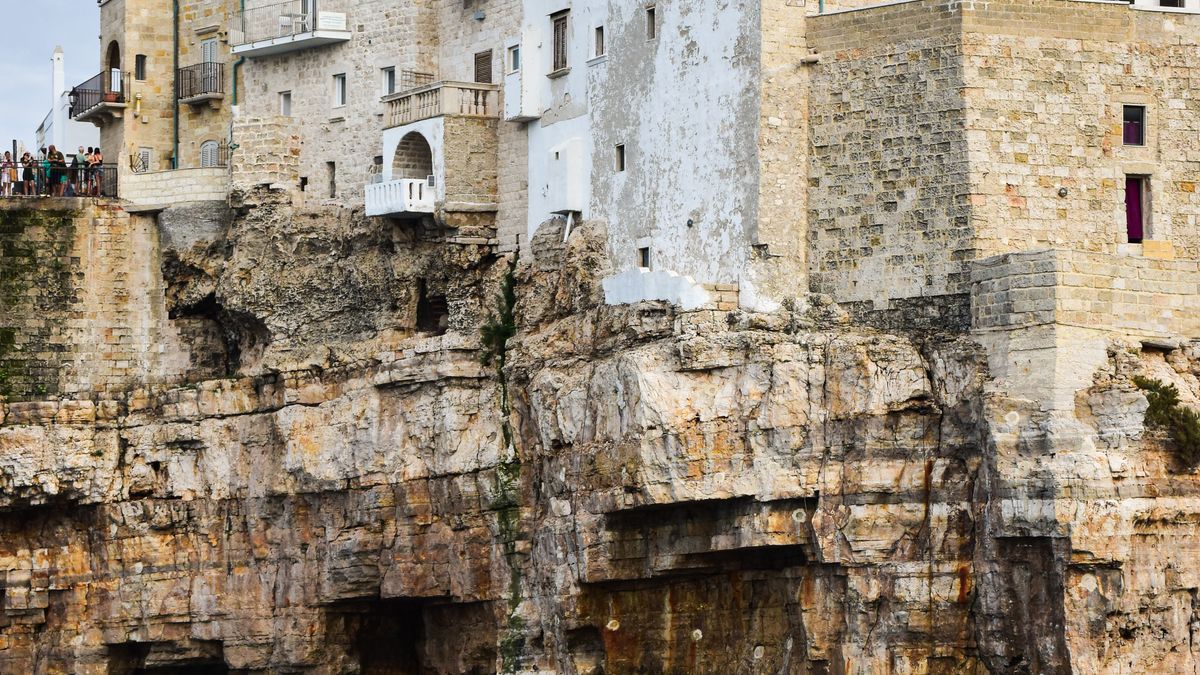
Polignano a Mare is the town built on a cliff over a turquoise cove. The beach in the middle of town, Lama Monachile, is the shot you have seen a hundred times. It is small and it gets packed in July and August, so go early or go in September.
Polignano works better as a day trip than a base for most people. The town is tiny and rooms are pricey for what you get in peak weeks. If you do want to sleep near the water, Borgobianco Resort and Spa sits in the countryside just outside town and gives you the coast without the old-town crowds. Down the coast, Monopoli is a quieter alternative with a working harbor and lower rates.

Trulli country, Alberobello and the quiet valley towns
Alberobello is where the trulli cluster thickest. A whole district of the town is nothing but these cone-roofed stone houses, and it is a UNESCO site. It is also the most touristed spot in the valley, so treat it as a morning visit rather than a base.
Sleep in the smaller valley towns instead. Locorotondo is a circular white town with some of the best views in the region and far fewer coaches. Cisternino is a slow food town where dinner means picking your meat at a butcher and having them grill it. Both have restored trulli you can rent, which is the one time we would say the novelty stay is worth it. A trullo for two in shoulder season runs around 120 to 180 dollars a night.

Lecce, the baroque city in the deep south
Lecce is a different Puglia. Bigger, browner, carved out of soft golden limestone into some of the most ornate baroque architecture in Italy. People call it the Florence of the south, which oversells it a little, but the old center is stunning to walk at night when the stone goes amber under the lights.
Lecce is a good second base if you want a city feel and easy access to the Salento beaches further south. Hotels here are cheaper than the Valle d'Itria on average because it is a real working city, not just a tourist town. Expect solid 4-star rooms around 130 to 160 dollars in shoulder season.
What each town is good for
Quick version if you are deciding where to sleep.
- Ostuni. First-timers, walkable dining, central location. Best all-rounder.
- Locorotondo or Cisternino. Quiet valley base, trulli stays, great food, fewer crowds.
- Monopoli. Coastal base with lower prices than Polignano.
- Lecce. City feel, baroque architecture, gateway to Salento beaches.
What a Puglia trip actually costs in 2026
Here are the numbers we tracked this year for the Valle d'Itria. A 3-star hotel averages about 116 dollars a night. A 4-star averages about 200 dollars. Five-star masserie, the restored farmhouse estates the region is famous for, average around 837 dollars a night and go far higher in peak August.
A midrange couple can do Puglia comfortably on roughly 250 to 350 dollars a day including a nice hotel, a rental car, two meals out, and entry fees. That is well under what the same trip costs on the Amalfi Coast, where a comparable hotel alone often clears 400 dollars a night.
When to go
Skip July and August if you can. The valley bakes past 35 degrees Celsius, the coastal towns are jammed, and rates peak. Late May through June and all of September are the sweet spot. September is our pick. The sea is still warm enough to swim, the crowds thin out after the first week, and hotel rates drop 20 to 30 percent from the August peak. If you only care about price, late October rooms are cheapest, but some beach clubs and restaurants start closing for the season.
How to keep the hotel bill down
Puglia rewards booking a base town and staying put rather than hopping hotels, since one-night rates carry a premium and cleaning turnovers eat your morning. Shoulder season alone saves you a quarter off peak. And book through a platform that gives money back rather than one that just quotes you the same rate as everyone else.
That last part is where Best comes in. Book your Puglia hotel through Best and you get 10 percent cashback on the stay. On a week in a 200-dollar-a-night masseria, that is around 140 dollars back in your pocket, roughly a night of your trip paid for. We built Best because the savings in travel should go to the traveler, not disappear into a booking platform's margin.
If you are still mapping the trip, our guides to why Europe's peak season is moving to the shoulder months and how to stack hotel savings in 2026 pair well with this one.
Frequently asked questions
Is Ostuni or Lecce a better base for Puglia? Ostuni for a first trip focused on the valley and trulli towns, since it is central and walkable. Lecce if you want a bigger city and plan to spend time on the Salento beaches to the south.
Do you need a car in Puglia? Effectively yes. Trains connect the main towns but run infrequently, and the best masserie and beaches are in the countryside. A rental car for the week is the standard move.
How many days do you need in Puglia? Five to seven is the sweet spot. That gives you a valley base, the coast, Alberobello, and a night or two in Lecce without rushing.
Is Puglia cheaper than the Amalfi Coast? Yes, meaningfully. Comparable hotels run 30 to 50 percent less, restaurants are cheaper, and the crowds are thinner outside peak August.
Images: Ostuni old town via Wikimedia Commons. Polignano a Mare via Pexels. Alberobello trulli by Martial75 and Lecce cathedral square via Wikimedia Commons. All used under license.